
New guidelines urge universities to specialise as demographic change and a tougher job market reshape talent demand
Editorial | Universities must rise to the Northern Metropolis challenge
Cross-sector push needed for youth facing ‘paradox of AI fluency’: minister
Opinion | China’s falling gaokao numbers offer a revealing snapshot
Discover MORE stories on
Chinese commercial reactor achieves nuclear fusion with clean hydrogen-boron fuel
China lights up ‘super microscope’ hopes with world-leading electron gun beam
Claims China’s BeiDou satellite was refuelled in orbit could change space race
Dannie Pengin Beijing
Published: 10:00am, 28 Sep 2026Updated: 10:07am, 28 Sep 2026
China has unveiled an overhaul of its university system, urging institutions to develop distinct roles as demographic change, a tighter job market and industrial upgrading alter the country’s skills needs.
The general offices of the ruling Communist Party’s Central Committee as well as the State Council, China’s cabinet, jointly issued guidelines for higher education reform, state news agency Xinhua reported on September 20.
The document said universities must adapt to “changing trends in the school-age population”. It urged institutions to pursue differentiated development, build more integrated forms of higher education and explore new ways to train future innovators.
In particular, Beijing called for universities to develop distinct roles. High-level research universities will be expected to support major national strategies, while industry-specific institutions must strengthen their capacity to serve the real economy.
“With the total school-age population shrinking and higher education transitioning from an elite to a mass model, everyone will have the opportunity to attend university in the future,” said Fan Xiudi, director of the Education Evaluation Research Centre at Shanghai’s Tongji University.
“This requires the education structure to adapt to changing demographic trends.”
Fan said a major element of the overhaul would be encouraging universities to develop distinctive strengths while helping students make the most of their individual aptitudes.
“In the past, all Chinese higher education institutions vied to become top-tier, comprehensive research universities with a full range of disciplines,” Fan said. “However, not all students excel academically, and everyone has different strengths.”
13:01
Why is China’s gruelling gaokao college entrance exam so tough?
The importance of cultivating a diverse talent pool has been repeatedly stressed in recent years. But Fan said it was unusual for the issue to be elevated to the central government level.
“My understanding is that the central government also feels this issue is extremely urgent and must be resolved,” she said.
“If China wants to become a leading educational nation, or to genuinely respond to individual development and societal needs, homogeneous development will be unsustainable.”
Demographic data underscores this urgency. The population across all school-age stages in China is forecast to fall rapidly after reaching its peak, with numbers from preschool to junior secondary level already in decline.
In 2022 researchers from Beijing Normal University and other institutions used national population census data to project a fall in China’s total school-age population from 328 million in 2021 to about 250 million in 2035. The university-age demographic is forecast to peak in 2032.
Meanwhile, higher education access has expanded massively over the past decade and a half. Total nationwide enrolment reached 48.7 million in 2025, representing a gross enrolment rate of 61.3 per cent – more than double the 30 per cent recorded in 2012 – according to the Ministry of Education.
“Such a massive higher education system cannot operate on a single track,” a ministry official was quoted as saying. “Policies must be applied to encourage universities to develop distinctive characteristics and better adapt to the diverse needs of the economy and society.”
Under a 2024-35 education development outline jointly issued by the Central Committee and the State Council in January 2025, higher education institutions are to be differentiated by research-, applied- and skills-oriented missions, with management and funding tailored accordingly.
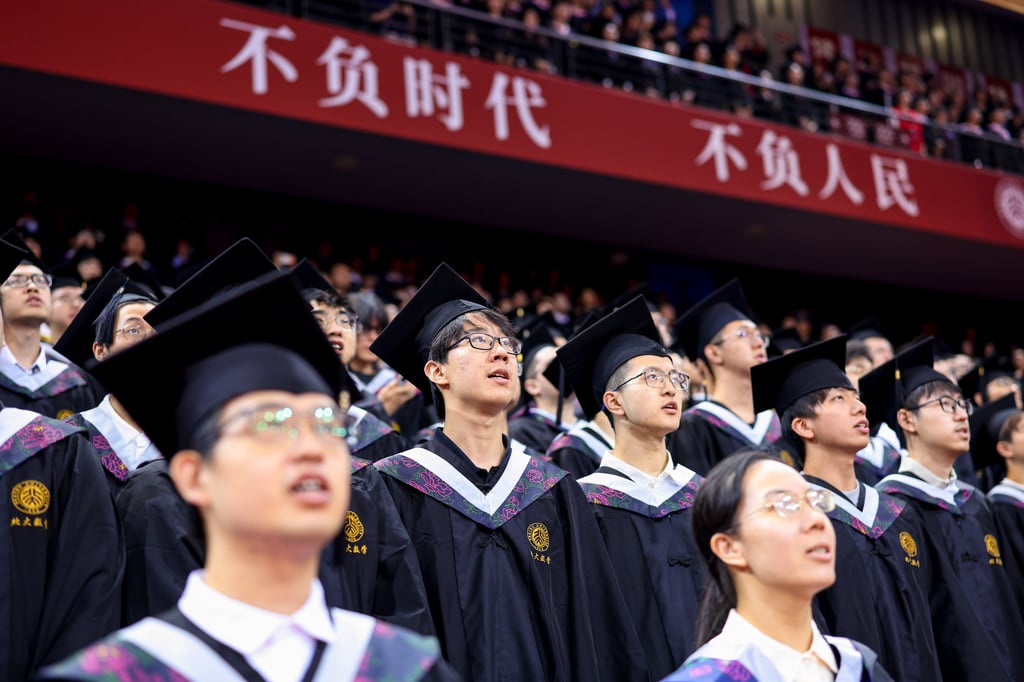
In an interview with Science and Technology Daily, Liu Zhentian, a professor of education at Xiamen University, said research universities would be the main bastions for cultivating top innovators needed to advance China’s scientific and technological self-reliance.
Applied universities would focus on regional development, helping to close the gap between talent supply and industry demand, Liu said.
Skills-oriented universities, meanwhile, would focus on nurturing artisans as well as technical personnel for the country’s modern industrial system.
Authorities will reportedly establish categorised incentive mechanisms, providing differentiated support based on each university’s functional positioning, actual contributions and distinctive advantages.
Although such categorised development has been advocated for years, the difference now is that external conditions are “undergoing substantial changes”, according to an analysis by Zhang Duanhong, director of Tongji University’s Education Policy Research Centre, and Liu Hong, a researcher at Fudan University.
The conditions that previously fuelled the homogeneous expansion of Chinese universities were beginning to unravel, the researchers wrote in a social media post on September 22.
A shrinking population was altering the student base, a tight job market forcing a rethink of talent supply, and industrial upgrading redefining demand, they said.
“Original innovation, technological development, engineering, industrialisation and on-site process improvements require the joint support of different types of innovation entities and talent,” they wrote in the post.
Given these shifts, the authors said, the main role of the new guidelines was to grant universities the policy space to make proactive adjustments now, rather than waiting to be “forced to transition” when student numbers dwindled, funding tightened and graduate employment worsened.
Date . 28/Sep/2026